“Not even a single drop of water should go to the sea.”
This phrase, voiced by agricultural engineer Ertan Uluca from Morphou/Güzelyurt, encapsulates both his approach to farming and his deep appreciation for water. More than a personal philosophy, it underpins a broader story in which this perspective has been transformed into tangible benefits for the local community, thanks to the EU-funded Wastewater Treatment Plant.
For many years, the Morphou/Güzelyurt region lacked a proper sewerage system. Household septic pits threatened both the environment and public health: uncontrolled discharges polluted groundwater, foul odours diminished the quality of life, and hygiene issues became widespread. Meeting the growing population’s infrastructure needs was proving increasingly difficult.
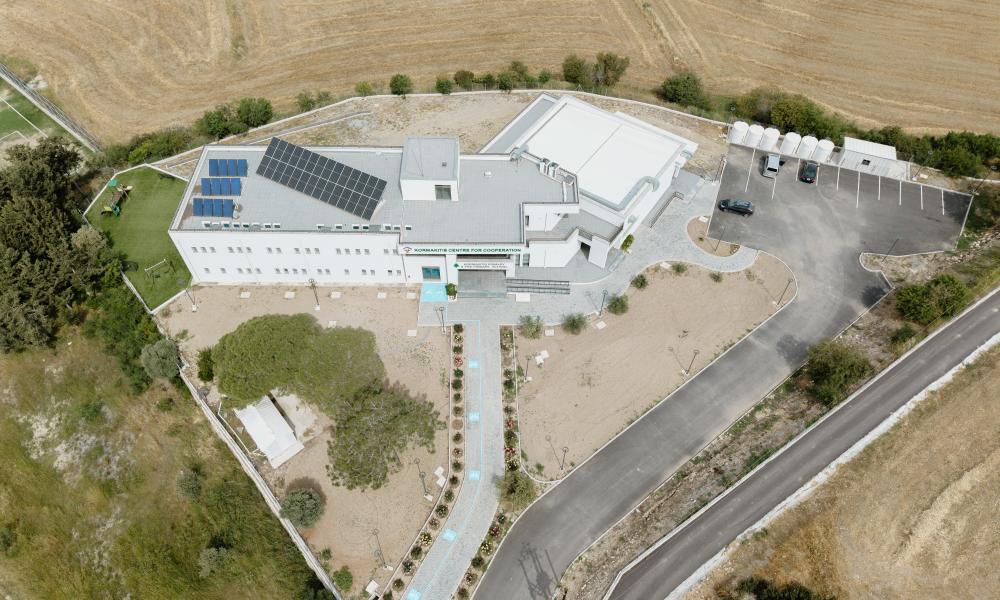
An initiative launched in 2005 led to the construction of the Morphou/Güzelyurt Wastewater Treatment Plant, designed to international standards and funded by the European Union under the Aid Programme for the Turkish Cypriot community. Between 2021 and 2023, UNDP implemented the EU funded extension of the plant through the Local Infrastructure Facility (LIF), which was completed in August 2023. With capacity expansion completed in 2023, the plant’s biological treatment capacity has risen to 2,694 m³ per day. The project modernised screens and grit chambers, biological and advanced treatment units, odour control systems, energy recovery, and emergency power supply. These improvements increased treatment efficiency while minimising the plant’s environmental footprint. Crucially, the upgrades allow treated water to be planned as a stable and predictable resource for agriculture.
Uluca highlights the plant’s importance in Cyprus’s dry climate. As climate change makes rainfall increasingly unpredictable, he warns against dependence on a single source and insists: “We must protect local water resources and reclaim every drop that would otherwise be wasted.” The reuse of treated water, particularly in olive and citrus groves, helps sustain yields despite seasonal fluctuations, offering complementary irrigation even in times of drought.
Another significant benefit is the prevention of nitrogen pollution in groundwater. The end of uncontrolled discharges is vital for both ecology and public health. Uluca praises the plant’s dual role: “It is extremely important both to prevent nitrogen pollution from seeping underground and to bring back reclaimed water for agriculture.” At the same time, he acknowledges its limits: while not recommending its use for crops whose leaves are eaten directly, he considers it a safe and sustainable alternative for irrigating trees.
Morphou/Güzelyurt remains the leading citrus-producing region in the north, and nearby Lefka/Lefke and Morphou/Güzelyurt farmland also supply a large share of vegetables. For such high-demand crops, integrating treated water not only simplifies production planning but also reduces pressure on underground wells. Uluca outlines irrigation needs with precision: olives require 800–900 cubic meters of water per year, while potatoes need around 400 cubic meters. In this light, treated water is not merely an “additional resource” but a strategic safeguard.
The project has also delivered clear socio-economic gains. The reduction in odours and hygiene problems, which had long disrupted daily life, has greatly improved the quality of life in residential areas, Uluca’s own household has now been connected to the sewerage system. For farmers, the plant provides a lifeline for maintaining irrigation schedules under drought conditions. Uluca explains the importance of diversification in water management: “We draw some from underground, some from reservoirs, and some from treatment. Over time, it is important that water from treatment is used even more, especially for tree irrigation.”
The region also faces a structural challenge: the waning interest of younger generations in agriculture. Yet modern infrastructure and efficient water use can make farming attractive once again. Increases in productivity, predictability in costs, and reduced environmental risks could open new opportunities for young people to return to agriculture. Uluca’s reflection captures this vision: “Recycling is the most important value, not only for water but for everything.”
In conclusion, this EU supported project has delivered more than environmental improvements. It represents a strategic milestone for the sustainability of regional agriculture, the protection of public health, and the efficient use of natural resources. As Uluca affirms: “Projects like the Morphou/Güzelyurt Wastewater Treatment Plant are indispensable for the future of water. The EU’s support for the environment and agriculture is of vital importance.”
About the project:
The Local Infrastructure Facility (LIF) is funded by the European Union under the EU Aid Programme for the Turkish Cypriot community and has been implemented by the United Nations Development Programme (UNDP) since 2018. Its purpose is to provide support and technical assistance for the design and delivery of projects that enhance environmental, social, and economic infrastructure in the Turkish Cypriot community. Projects are awarded through a competitive process to ensure value for money and build community capacity, with emergency support provided when required. UNDP manages all aspects of implementation, including feasibility studies, project design, procurement, construction, supervision of works, preparation of tender documents, and management of supply contracts. Since 2018, the European Commission has allocated approximately EUR 36.67 million to LIF activities.
For more information: https://www.undp.org/cyprus