Kormakitis Centre for Cooperation: A Space Where Peace and a Sense of Belonging Grow
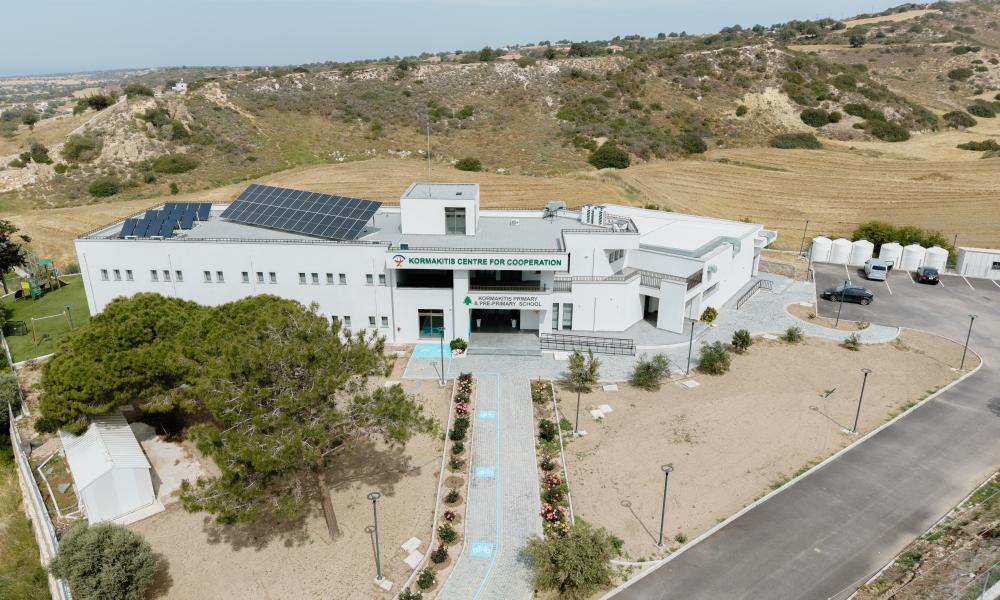
Surrounded by olive trees planted as symbols of peace and hope, the quiet streets of Kormakitis open into a lively meeting point: Kormakitis Centre for Cooperation…
Once an empty and derelict school building in the heart of this historic Maronite village, the site has been transformed into a vibrant hub where children’s voices echo through the corridors, summer camps and workshops bring people together, and the past feels alive again. For Vassilis Koumettou, 35, the Centre is not just a building; it is a deeply personal achievement. Born to parents from Kormakitis and now working as the parliamentary assistant to the Maronite community’s representative, he played a key role in bringing the project to life.
“The idea came from Mr. Moussas Yiennakis and Mr. Antonis Skoullos,” Vassilis recalls. “I worked alongside them to prepare the proposal for the European Commission, meeting with UNDP and EC representatives until the project became reality as part of the Local Infrastructure Facility project (LIF). When we opened the Centre in March 2023, it felt like a dream realised.”
For the Maronite community, the Centre serves two intertwined purposes: it is both a bridge to reconciliation and coexistence across Cyprus, and a lifeline for the survival of the village itself. Since its opening, it has hosted a wide range of activities from the Sanna[1] language camp, dedicated to preserving Kormakitis’ ancient dialect still spoken by around 1,000 people, to youth programmes, bicommunal conferences, and cultural events. “The Centre is a vital tool for keeping our language alive,” Vassilis says, adding that the dormitory facilities now allow events to be held entirely within the village.
For older residents who once studied in the old school, seeing it full of life again stirs deep emotions. “For decades it was empty. Now, to see it buzzing with children and community events is something extraordinary,” Vassilis reflects. The presence of a primary school and kindergarten within the premises is especially important, it encourages young families to return, ending long daily commutes to Nicosia and restoring a sense of local life.
The change is already visible. Graduation ceremonies now draw over a hundred attendees, convincing more families that the village can offer a vibrant place for their children to grow up. Beyond education, the Centre has become a shared home for all Maronite villages, with activities like traditional cooking lessons, cultural walks, and seasonal events such as the annual tulip walk.
It is also a space of openness and exchange. In the past two years, the Centre has welcomed ambassadors, international visitors, and organisations from across the island, such as the Cyprus Friendship Programme and the Association for Historical Dialogue and Research. “In a village like Kormakitis, we can be a great example of communities living together,” Vassilis says. “Visitors from all communities can feel this is their shared home: a centre of peace and coexistence for Cyprus.”
For younger members of the Maronite community, the Centre has sparked a reconnection with their roots. The hope is that more young families will be encouraged to move back permanently, revitalising the village. With the primary school reopening in April 2024 and the number of pupils already growing, there is optimism that life in Kormakitis will continue to flourish.
Vassilis dreams of a Centre alive with the sound of children in its classrooms, hosting international collaborations and cultural festivals, and contributing not just to the village, but to the vision of a reunified island. “I imagine a place full of activity, full of life and Kormakitis that welcomes everyone,” he says.
About the project:
The Local Infrastructure Facility (LIF) is funded by the European Union under the EU Aid Programme for the Turkish Cypriot community and has been implemented by the United Nations Development Programme (UNDP) since 2018. Its purpose is to provide support and technical assistance for the design and delivery of projects that enhance environmental, social, and economic infrastructure in the Turkish Cypriot community. Projects are awarded through a competitive process to ensure value for money and build community capacity, with emergency support provided when required. UNDP manages all aspects of implementation, including feasibility studies, project design, procurement, construction, supervision of works, preparation of tender documents, and management of supply contracts. Since 2018, the European Commission has allocated approximately EUR 36.67 million to LIF activities.
For more information: https://www.undp.org/cyprus
[1] Cypriot Maronite Arabic, locally called “Sanna” (Σάννα/سانّا)is a peripheral Arabic variety historically centered in Kormakitis; it’s classified as severely endangered (ISO 639-3: acy), with recent reports estimating only about 1000 speakers remaining.