My First Menstrual Period Package at School: A Success Story That Breaks Taboos
For many years, just as in many other parts of the world, preparing young girls for puberty remained a neglected issue in the northern part of Cyprus. The menstrual cycle appeared briefly in textbooks, often reduced to a few lines, and was treated as a subject best avoided. Families and teachers lacked the vital information girls needed; as a result, most girls experienced their first period unprepared, anxious, and frightened.
It was this longstanding gap that motivated the Cyprus Women’s Health Research Initiative (KISAD) to take action. Supported by the European Union funded Civic Space Small Grants Programme, they launched the “My First Period Menstrual Package at School" project: an initiative designed to challenge taboos and replace fear with understanding. To help address this critical need, the Cyprus Women’s Health Research Association (KISAD) implemented the “My First Menstrual Period Package at School" project with the support of the Grow Civic (Sivil Büyü) programme, an active citizenship and capacity-building initiative funded by the European Union under the Aid Programme for the Turkish Cypriot community and implemented within the framework of the Civic Space Project.
The aim of the project was clear. It sought to ensure that young girls could learn about their bodies with confidence; that families could support their children throughout puberty; and that teachers could guide their students with accurate and reassuring information.
Naciye Fikretler, a biology teacher and board member of KISAD, recalls the moment of realisation:
“We noticed that children did not have sufficient knowledge about their own bodies. Seeing how little we collectively knew about menstruation, and understanding how this lack of awareness created fear and anxiety, motivated us more than anything else to begin this programme.”
During the preparation phase, the association carried out a detailed review of all school curricula. What they found was striking. Fikretler summarises the situation: “Apart from the biology course in high schools, menstruation appears in middle schools only as a word. It is not explained. If children do not receive any information at home, they encounter bleeding without understanding what it is. That is truly frightening.”
To address this vital need, the project followed a three-stage approach. First, guidance counsellors received training to strengthen and update their biological knowledge. Afterwards, meetings were organised for parents. Drawing on her own experience, Fikretler remarks: “As the mother of a teenager, I know that puberty is daunting even when we read and learn about it. There are also parents who do not read or learn at all. For them, I believe we became a valuable point of access.”
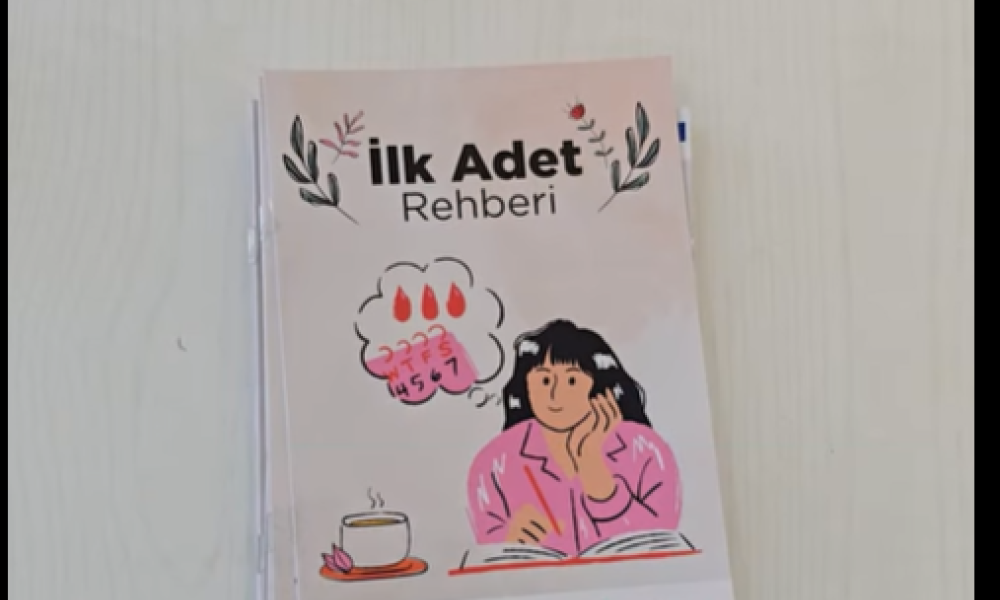
The final stage focused on young girls. They took part in comprehensive sessions and received specially prepared informational leaflets. These leaflets were designed in several languages: Turkish, English, Russian, and Farsi. This multilingual approach ensured that families and students with different linguistic backgrounds could access the same essential knowledge.
Associate Professor Dr Filiz Yarıcı, who is both a parent and a midwife with twenty-one years of experience, made a significant contribution to the project. Her message is simple yet striking:
“People fear what they do not know. Do not fear menstruation; fear misunderstanding it. The more you understand your own body, the more confidently you can manage this physiological process.”
There is one memory that left a lasting impression on Yarıcı: “A mother called me after hearing that I would be giving a session at her daughter’s school the following day. She asked about the content. I explained our purpose and the importance of what we teach. She said, ‘Thank you not only for my daughter, but for all girls and all mothers in Cyprus.’ That moment touched my heart. I knew we were on the right path and that we must continue.”
The journey, however, was not without challenges. Yarıcı reflects on the wider societal barriers:
“Throughout history, the female body has been treated as taboo, something people avoid speaking about. Whenever we attempted to speak about it, society tried to silence us. Yet we persisted. Our purpose was different: we wanted young girls to understand their bodies and recognise menstruation as a healthy, natural process.”
Over time, the transformation among students became evident. Girls who first approached the subject with fear began to relax as they learned that menstruation is a natural part of life. Fikretler explains: “Before the training sessions, children viewed menstruation as frightening and worrying. Afterwards, they accepted it as normal: part of life and a natural process of womanhood.”
A major achievement of the project is its lasting effect. Yarıcı shares this milestone with pride:
“Sustainability was our priority. Menstruation is now included in the service training programmes for guidance teachers. This is a significant success. Our next aim is for the topic to be introduced into the curriculum and taught to younger age groups.”
The support provided by the European Union through the Civic Space Programme proved essential. Yarıcı explains: “A small dream grows into a meaningful transformation thanks to Civic Space. We want to make a difference, and financial support helps turn our ideas into reality.”
Today, thanks to “My First Menstrual Period Package”, young girls learn about their bodies without fear; families feel more confident supporting their children during puberty; and teachers have the tools to guide their students with accurate information. A subject once hidden behind a veil of taboo has become one that is openly discussed and widely taught, making the lives of young people that much easier.
About the Project:
Civic Space is an EU funded technical assistance project under the EU Aid Programme for the Turkish Cypriot community. Its overall aim is to help build a stronger civil society in the Turkish Cypriot community—one that supports democratic change and confidence-building measures. Running from December 2020 to December 2025, the project focused on four key outcomes: increasing public engagement in civic action, strengthening the role of Civil Society Organisations (CSOs) in decision-making, promoting a more enabling environment for CSO activities, and fostering stronger links with CSOs in the Greek Cypriot community. The implementation of the new technical assistance project Civic Space-Continuous Support to Civil Society Organisations in the Turkish Cypriot community started in December 2025 and will last 30 months. The overall objective (Impact) to which this action contributes is to building, in the TCc, a stronger civil society, which promotes the EU values, supports the democratic change and the Cyprus settlement process.
For more information: https://civicspace.eu/en/