“Peace is not just a handshake at the table; peace is like the sky — we can all exist beneath it.”
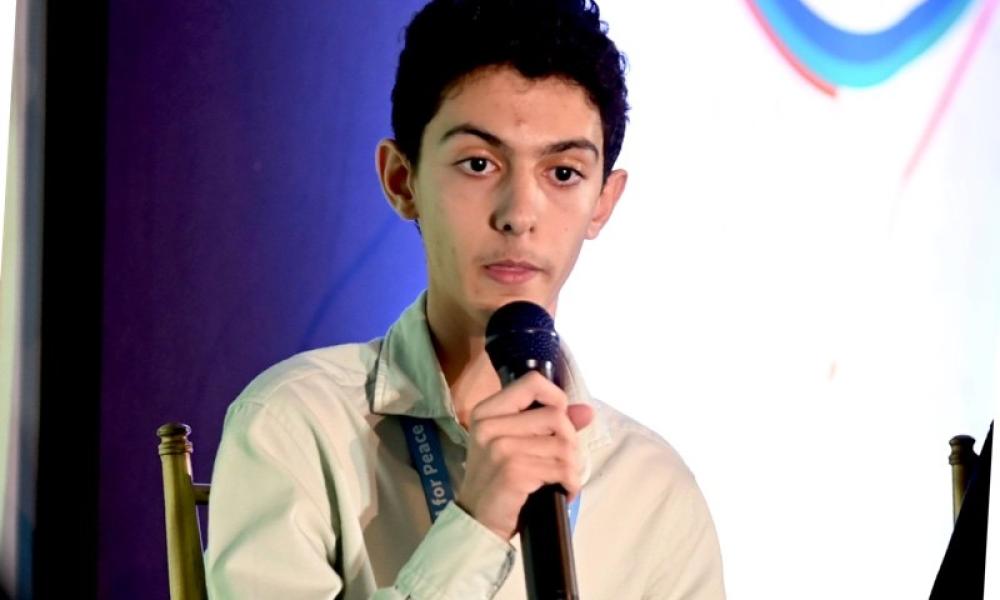
Fifteen-year-old Tuğra Vurana, an 11th-grade student at Türk Maarif College, is part of a generation of Cypriot youth who have grown up with the reality of a divided island. For him, never having met his Greek Cypriot peers has always felt unnatural. “In a globalised world, we can meet people from different countries, so why can’t I meet people who share the same island with me?” he wonders.
His search for an answer took a new direction when he discovered the short-term programmes offered for Cypriot youth by United World Colleges Cyprus (UWC Cyprus) via the EU Scholarship Programme. Encouraged by his teachers and friends, Tuğra applied for one of the workshops he came across on social media. From the very first day, the programme became more than just a learning space — it became a journey that reshaped his identity, his view of society, and his hopes for peace.
Supported by the European Union, UWC Cyprus, via the EU Scholarship Programme, works to bring young people from across the island together, reduce social division, and build bridges between communities. Growing up without contact with peers from the other community often fosters prejudice, distance, and a sense of unfamiliarity. Through its short courses and scholarship programmes, UWC Cyprus helps bridge this divide by offering young people the chance to meet, collaborate, and explore shared challenges from new perspectives.
For young people raised in a divided landscape, these programmes represent more than an educational experience — they are a practical encounter with peace. Bringing together students from different communities not only breaks down personal stereotypes but also nurtures a sense of shared identity and belonging. According to Tuğra, this is one of the most meaningful contributions UWC Cyprus makes toward overcoming division on the island. He says that through these opportunities, his belief in the role of youth in building peace has deepened — for him, “peace becomes possible when social relationships grow stronger.”
Tuğra has so far participated in two short-term workshops organised by UWC Cyprus. His first programme was a hybrid experience, beginning with online sessions and continuing with in-person activities in the historic village of Platres, at the foothills of the Troodos Mountains. During this workshop, students explored questions of identity and values — conversations that encouraged him to reflect on perspectives he had never considered before.
His second programme, held in 2025 in Agros — the village famous for its rose gardens — was a two-week experience where participants met their Greek Cypriot peers from the very first day. By the end, they felt like a family. With workshops ranging from photography to identity studies, and from social perceptions to peacebuilding, Tuğra says the programme profoundly expanded his understanding of the world.
The friendships formed during these courses did not remain confined to the workshop venues. Just a week after the programme ended, around twenty participants from both communities met again in the southern part of Nicosia. It was Tuğra’s first time crossing to the south without his family — an evening he describes as “unforgettable, full of conversations and laughter.” This small but meaningful step strengthened his sense of independence and responsibility and gave him renewed hope for the island’s future.
One of the most lasting impacts of Tuğra’s UWC Cyprus experience has been his motivation to take action. Following 'EU-UWC United for Peace Forum' he and his workshop friends launched an initiative called “Bicommunal Cy.” Their aim was not only to reconnect participants of the EU-UWC Scholarship Programme but also to include young people who had never taken part in such programmes. During events held in the Buffer Zone, they explored peace education practices from around the world, drawing on examples from post-conflict societies such as Colombia and Rwanda. For Tuğra, these discussions help young people broaden their perspectives and challenge deeply rooted social prejudices.
He summarises the value of UWC for young people in Cyprus in his own words: “These programmes teach us to think more broadly, break prejudices, and act together.”
And his message to other young people is equally clear: “Definitely apply. UWC is not just an education; it’s an experience that transforms people and society.”
Looking ahead, Tuğra hopes to study economics — a field he came to appreciate through his UWC experience as essential for driving social change and civic engagement. He dreams of attending a good university in Europe and returning to Cyprus to contribute to his community. No matter where life takes him, he says he will always come back: Cyprus is not only the place where he was born — it is the home where he wants to build his future.
About the programme:
The EU Scholarship Programme for Cypriot Youth at UWC aims to build mutual understanding between Cypriot communities. Funded by the European Union under the Aid Programme for the Turkish Cypriot community and implemented by UWC, the programme started in 2019 and since then it awarded more than 80 scholarships to Cypriot students to attend a two-year programme at a UWC school in Europe (UWC Adriatic, UWC Maastricht, UWC Mostar, UWC Red Cross Nordic and UWC Robert Bosch College). The programme also includes short courses and UWC Experience workshops, bringing together youth from Cyprus, Europe and the Mediterranean region.
More information: https://cy.uwc.org/about-uwc-nc-name/